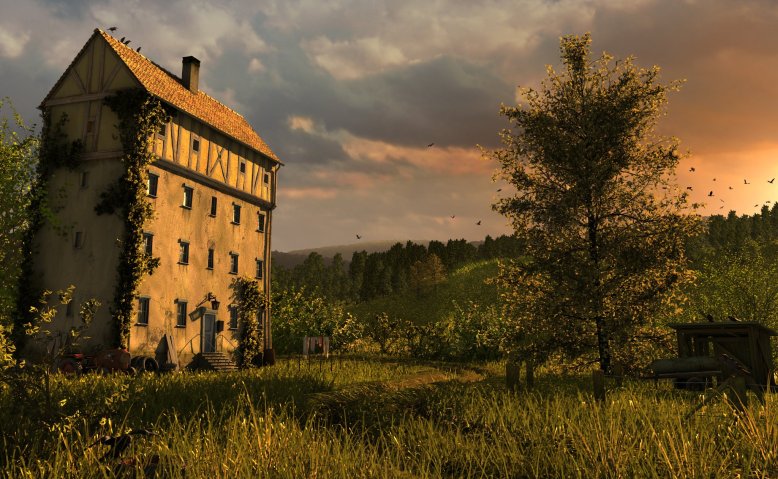
3D scene created in Blender
Compared to its 2D big brother, the 3D animation industry is a young one. The first 3D animation was created by the Swedish Royal Institute of Technology in 1961, and it wasn’t until Pixar created Toy Story in 1995 that 3D full-length feature films started to be created. Compare this to Disney’s first hand-drawn 2D animated movie, Snow White, being created in 1937 before they could even conceptualize a 3D graphic, and you have a very new industry.
Because of its age, the 3D animation industry is rapidly changing and evolving, still refining the process animators go through to create 3D animations. This results in many new 3D animation programs being released every few years.
But, like any competitive market, some of these programs rise to the top and some sink to the inky depths of obscurity.
One program that has dominated the industry since its creation is the industry standard Autodesk Maya. A modeling, effects, and animating program, Maya was developed in 1998 and has since become common in many animation studios, such as Disney and Pixar. It has been used to help create popular films such as Avatar, Finding Nemo, and Frozen, as well as have a hand at visual effects in TV shows like Game of Thrones, The Walking Dead, and South Park.
But is this program really the only one that could be considered “industry standard”?
A 3D and 2D modeling, effects, and animating computer program called “Blender” is beginning to create some serious competition for Autodesk Maya. Created in 1995 by the Dutch animation studio NeoGeo, Blender didn’t truly start to become the program it is today until 2002 when it was released to the public under with a GNU General Public License. This license meant that Blender was free of copyrights and could be distributed freely to the public, being used and modified by people in any way they want.
Blender then became the best free animation program in the world.
Despite its high popularity, many animators do not see Blender as “industry standard”. Major animation companies do not advertise if they use Blender or not. Few independent organizations proudly declare their use of the free program. Although many amateur animators start off using the program, they are forced to move to Autodesk Maya when they enter the professional field.
So the question is, why is a program that can do even more than Maya so shunned?
There are many potential reasons. One could be that Maya has a lead on popularity in the industry since Blender’s use began nearly four years after Maya’s. Another could be bias, since Maya is a pay-to-use program and thus could be considered more professional of a program than Blender. But the primary potential reason is the “industry standard” stamp that Maya flaunts.
Blender can’t boast that it was used in Disney Films or popular TV shows. If a studio is looking to create an animation similar in quality to, say, Disney’s “Up”, they’ll look and see what programs Disney used to create the film. When they see that Disney used Maya to create the film, they’ll go purchase the program so they can use it to create animation on par with “Up”. This results in Blender being ignored completely by independent studios looking to make it in the animation world.
Whatever the reasons could be, it’s no doubt that Blender lags behind Maya in the professional world. What does this mean for independent animators looking to make it in the industry? Well, it means they have a choice: buy Autodesk Maya or try their luck with free-to-use Blender. Since Blender is constantly being developed by its creators and community, the future of the program in the animation industry is uncertain. It’s no question that it’s a powerful program, so its lack of use in the industry could change in the future.
It’s up to the animators to either help Blender along or let it fall to the wayside and fade away as just another obscure animation program.
 Katie T. Mills